WHAT IS GOOD LEADERSHIP?
Going Back to Basics
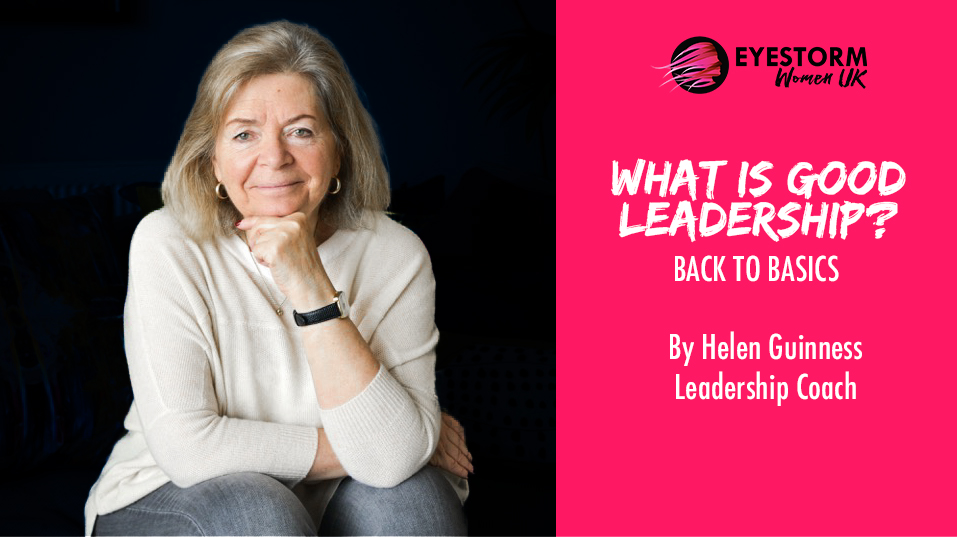
Helen Guinness is a Leadership and management consultant, a transformational coach and our EyeStorm Women Wise Owl.
In this blog, Helen shares her journey into leadership coaching and goes back to basics to explain what a good leader is and why we need them.
LEADERSHIP – Back to Basics
Where to start? At the beginning, I suppose…
I was born in Greece, at a time of civil war.
🚸 The Greek Civil War took place from 1946 to 1949. The conflict, which erupted shortly after the end of World War II, consisted of a communist-dominated uprising against the established government of the Kingdom of Greece.
Six years later we moved to Yugoslavia.
🚸 Several fundamental reforms in the early 1950s, brought about change in three major directions: rapid liberalisation and decentralisation of the country’s political system, the institution of a new, unique economic system and a diplomatic policy of non-alignment. Tito was Yugoslavia’s President.
Nigeria next, in 1958. More changes afoot: a new Federal Constitution in 1954: the separation of Lagos (the nation’s capital) from the Western Region and the establishment of a Federal Government for Nigeria comprising three regions, namely North, West and East resulting in Central and Regional Government. Nigeria gained independence in 1960 and became a republic in 1963, the year we left.
And so, to Lebanon. Lebanon reached the peak of its economic success in during the 1960s. It was seen as a bastion of economic strength by the oil-rich Persian Gulf Arab states, whose funds made Lebanon one of the world’s fastest growing economies.
Four different cultures, four different types of leadership. Four different languages. I didn’t experience democratic leadership until settling in the UK aged 18.
MY PASSION FOR LEADERSHIP
Simon Sinek says:
“So goes the leader, so goes the culture. So, goes the culture, so goes the company.”
Whether it is the country or the company, it’s the leadership that creates the culture.
Briefly, I lived life backwards so to speak; I was a parent at nineteen, I attended teacher training college in the mid-seventies and university in the early eighties. I have been married three times, have two children, four grandchildren and two great grandchildren.
I had no idea what I wanted to do with my life, all I was certain of was that I wanted to be independent and earn my own living. So, I had various jobs which included sales and retail, teaching and interpreting, PR for the travel trade and practice manager for a firm of architects.
Then, in 1981, whilst attending a personal development programme, I realised that this was the career for me.
At about the same time I was introduced to and enrolled in The Hunger Project, https://thehungerproject.org.uk/about-us/our-work/, whose mission is quite simply, to end hunger; not by providing food, shelter or money, but by developing indigenous leaders. Those leaders, mostly women, discover how to transform their lives from being victims of circumstance to creating futures free from hunger and poverty.
I saw leadership in action, the power of taking responsibility and transformation taking place. That was when I knew that leadership was so important.
And I saw that anyone can be a leader.


My new career began by volunteering with The Hunger Project, then teaching in Winchester Prison – that was an eye opener! – and working for a Management Consultancy for a couple of years.
In 1989 I founded my own consultancy, pioneering leadership and coaching at a time when they didn’t exist as distinctions in the UK. I designed and delivered multiple programmes to a vast range of organisations, ranging from Pepsi Cola to professional practices.
Time, experience, research, observation – oh, and a lot of listening – have convinced me that leadership today is still misunderstood, misdirected, abused, misconstrued and malfunctioning.
It is time for change.
WHAT IS THE FUNCTION OF LEADERSHIP? WHY DOES IT MATTER?
Leadership is future focused. Its function is to connect people with purpose (mission, vision) and inspire them to work towards fulfilling that purpose. The purpose needs to be crystal clear, engaging and bigger than seems, on the face of it, achievable.
Leadership is more than the predictable future; it lives in the unpredictable future. That is what makes it exciting and that is what people are inspired to follow.
And without followers, there is no leadership.
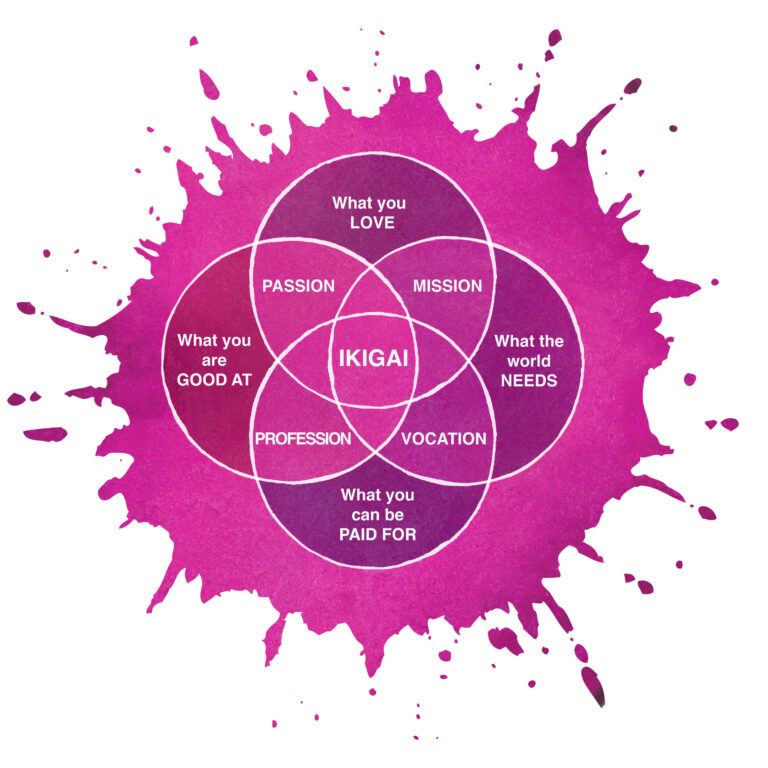
I have long been a follower of Ikigai. Ikigai (生き甲斐), is a Japanese concept that means “a reason for being”. The word refers to having a direction or purpose in life, that which makes one’s life worthwhile, and towards which an individual takes spontaneous and willing actions giving them satisfaction and a sense of meaning to life.
Ikigai is the union point of four fundamental components of life: passion, vocation, profession and mission. In other words, where what you love meets what you are good at, meets what you can be valued and paid for, meets that which the world needs.
We all need a sense of meaning in our lives, a reason for getting out of bed in the morning, something to motivate us, something that helps us to feel we are making a difference.
As an employee, you need to feel that you are part of something worthwhile, have a sense of belonging, feel that you are contributing to the whole. Strong leadership engenders that sense of belonging, knowing that you play an important part in the fulfilment of the organisation’s purpose.
Strong leadership inspires ‘spontaneous and willing actions’ towards the fulfilment of a purpose.
Leaders must believe in and stand for the purpose themselves. A leader who cannot or does not believe in the purpose will be inauthentic and will not be able to bring others with them.
Leadership is not to be confused with Management. The function of management is based in the present, the day-to-day delivery of the results required in order, ultimately, to fulfil the purpose. The job of management, just as important as leadership, is to use the resources (mostly human) available to get the work done, to get the results needed.
Leadership focuses on the destination, whereas Management focuses on how to get there.

ARE LEADERSHIP AND MANAGEMENT ROLES INTERCHANGEABLE?
Yes, they are, but it’s knowing when to be either a leader or a manager – maintaining the distinctions – that makes the difference.
In my life, I am both. I am clear what my purpose is (leadership) and remind myself very regularly what it is because that ensures that the actions I take (management) will be consistent with the fulfilment of my purpose.
Leadership is a relational practice. What does that mean?
Relationship is the foundation of accomplishment. It is through relationship that we achieve, that we fulfil our purpose. We can’t all work in isolation (indeed, that is one of the problems we currently face as a post Covid nation) and expect to achieve when we are disconnected from the whole. Even those who have chosen to cross the seven seas alone in rowing boats have done so based on multiple relationships.
Leaders won’t create followers without relationship and given that that is a key function of Leadership, connecting with people is vital.
Leaders need to command respect and a culture of listening. Leaders need to be seen to be walking their talk, to use a rather dated expression.
Nurturing relationships requires communication (amongst other things). We are notoriously poor in that domain. We don’t say what we mean, and often don’t mean what we say. And we don’t listen. Learning to listen, really listen, not just hear, is a skill. It requires commitment, awareness and energy. But it brings enormous dividends.
Listening is a vital and integral part of my job. If I don’t listen to my clients, I can’t deliver what they want.
Listening leaders are the ones who discover what people want, what they don’t want and what is missing for them. Only by listening are leaders able to address those matters and put them right.
Strong relationship requires listening. All too often relationships break down for the lack of listening. By listening to people, you are showing that you care, that what they have to say is important, has value.
One of the greatest gifts that you can give another person is to listen to them in a way that they experience being heard and recognised.
So much of leadership is about communication. I have done a good deal of work with clergy, who struggled with leadership (and management come to that) but who had learnt the skill of standing in the pulpit and communicating an inspiring message. Generally, they were good at connecting with their purpose and communicating it in an engaging manner.
But they had been trained to do that.
That brings me to a worrying issue:
TRAINING – OR THE LACK OF IT
Time and again people are promoted outside their comfort zone. A person can be a brilliant salesperson, for example, and based on their results, will be promoted to Sales Director (a leadership role) without any training. Being brilliant at selling doesn’t mean you will be brilliant at leading.
Why do we promote people out of their level of competence into a role in which they find themselves incompetent?
That can be a terrifying experience. What then happens is people fail in leadership. Remember, what Simon Sinek said about leadership and culture:
“So goes the leader, so goes the culture; so, goes the culture, so goes the company.”
What kind of culture does failing leadership create in an organisation?
It is a great sadness to me that apparently, we don’t care enough to want people to succeed. A strong leader, a relational leader, will inspire fulfilment in others as well as the accomplishment of purpose. When people feel they are cared for, recognised and valued, they spontaneously and willingly give more. Happy people are motivated to take more on, to challenge, to innovate and to enjoy their jobs. Unhappy people become less and less motivated and eventually give up. (The statistics showing the extent of mental and physical illness and absenteeism are horrifying.)
There is one more important point that I need to make about leadership.
Back to The Hunger Project and the grass roots leadership development. By creating a vision – a purpose – of a different future for themselves, the people in remote villages realised that they had to take responsibility for their own lives if they were going to succeed in realising that future. Taking responsibility or ownership, is empowering. Abnegating responsibility and blaming others is disempowering. They understood that by blaming others (governments, councils) they were giving away their power. By taking ownership, they empowered themselves.
The word ‘responsibility’ has a bad rap – inevitably, it is associated with blame. That is why I use the word ‘ownership’ instead.
By taking responsibility, ownership, of ourselves, our lives and the circumstances we work in, we stand a much better chance of removing the obstacles that stand in the way of fulfilment. Blaming others is not going to solve our problems, nor does it encourage strong, inspiring leadership.
There is much more that I could say about leadership and the importance of strong leaders in all our organisations. I hope I have given you a feel for the essence of leadership and left you wanting to know more.
I leave you with this thought:
The joy of leadership comes from seeing others accomplish much more than they ever thought themselves capable of.
Helen Guinness 2024
For more information on Leadership Development please contact me at [email protected]
Photo credit: Mi Elfverson
Ikegai infographic: Adobe Stock